
If white is your thing aesthetically, you’re in for a treat. White microphones are having a moment right now, and there are more quality options on the market than ever before.
Whether you’re a singer, presenter, public speaker, or a new gaming streamer, the right mic can change how your audience hears you. Same goes for students studying from home, or teachers stuck running classes through a webcam.
You’ll need a dependable piece of gear that carries your voice clearly to whoever’s on the other end of the stream, class, or studio. The days of getting by with a laptop’s built-in mic are long past.
If that sounds like you, this roundup should help. I’ve put together a list of the best white microphones currently available, covering everything from desktop USB mics to broadcast-style hanging options.
Quick Comparison Chart
| # | Product | Our Rating | ||
|---|---|---|---|---|
| 1 | 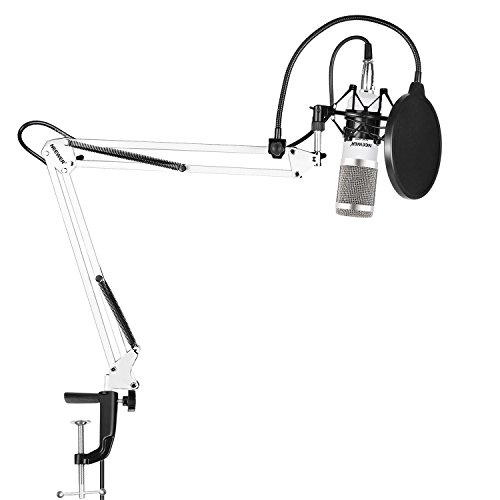 |
Neewer NW-800 Pro studio broadcasting | ★★★★★ | Check Price |
| 2 |  |
Blue Yeti USB Mic | ★★★★★ | Check Price |
| 3 | 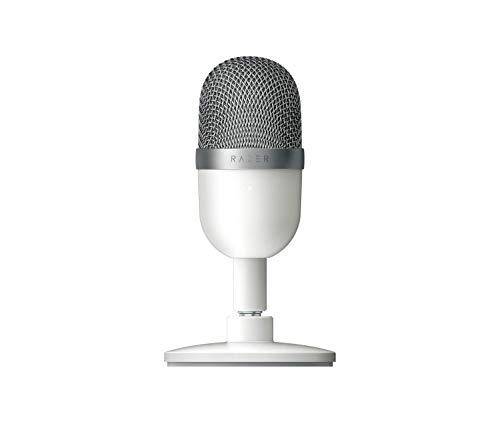 |
Razer Seiren Mini USB Streaming | ★★★★★ | Check Price |
| 4 |  |
Samson Go Mic | ★★★★★ | Check Price |
| 5 | 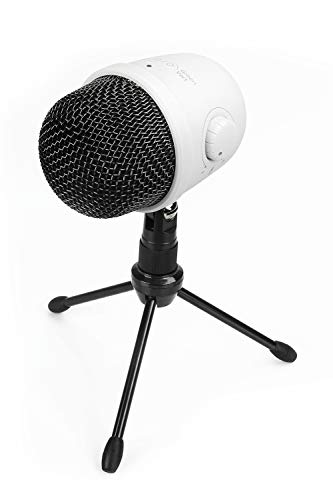 |
Amazon Basics Desktop Mini Condenser Mic | ★★★★★ | Check Price |
| 6 |  |
BM-800 Condenser Microphone | ★★★★★ | Check Price |
| 7 | 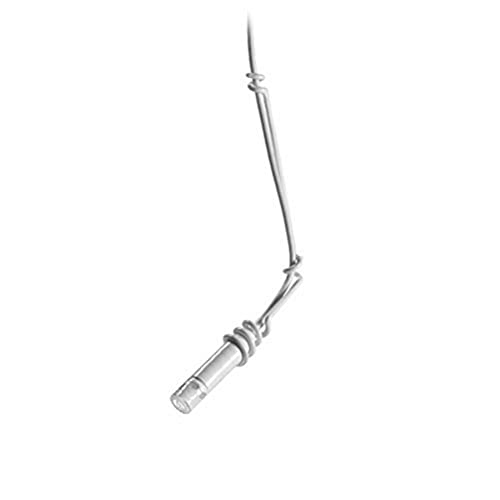 |
Audio-Technica PRO 45 ProPoint Cardioid | ★★★★★ | Check Price |
| 8 |  |
Shure CVO | ★★★★☆ | Check Price |
| 9 | 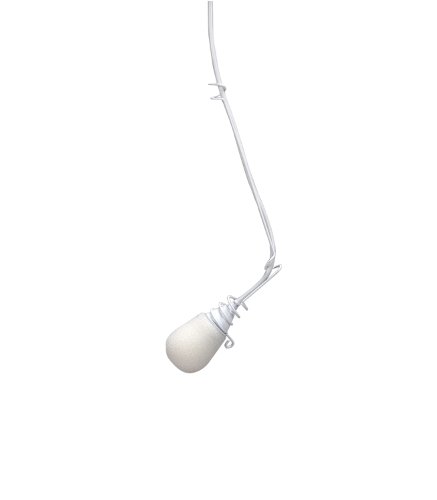 |
Peavey VCM 3 Choir Microphone | ★★★★☆ | Check Price |
| 10 |  |
LEWITT LCT 240 Pro Condenser Microphone | ★★★★☆ | Check Price |
1. Neewer NW-800 Pro studio broadcasting — Best Overall
Neewer NW-800 Pro studio broadcasting
This microphone is brought to you by Neewer, a brand that has consistently given us durable and sturdy microphones.
Pros
- All-metal white body handles daily studio and streaming use
- High-output condenser capsule delivers clean, detailed audio
- Built-in noise filtering keeps recordings free of room hum
- Unidirectional pattern isolates your voice for personal broadcasting
Cons
- Documentation lacks detailed setup guidance for beginners
- Frequency response may not suit all voice types equally
Neewer has built a reputation for producing sturdy, no-nonsense microphones at budget-friendly prices, and the NW-800 continues that trend. It’s one of the easiest picks for a first serious upgrade.
This is a desktop mic that mounts to your workspace and works with any PC or laptop. The XLR connector means you’ll need an interface, but the full kit makes that part painless.
What you actually get is a NW-800 Professional Condenser Microphone, styled cleanly in white and silver. The metal body weighs 11 oz (316g), giving it a reassuring heft without being unwieldy.
Also in the box: the white NW-35 scissor arm stand, rated for loads up to 1 kg, built from metal with double-braced arms and a powerful spring. You also get a black shock mount, a pop filter, a foam cap, and a table mounting clamp.
The pop filter and foam cap do most of the heavy lifting for clean vocals. They keep handling noise, wind, and plosives out of the recording, so your voice comes through clearly regardless of room conditions.
The metal chassis is durable and foldable, which makes it surprisingly easy to stow when you’re not using it. For a desktop setup on a budget, it’s one of the best values going.
2. Blue Yeti USB Mic — Runner Up
Blue Yeti USB Mic
It's a battery-powered powerful microphone brought to you by the company, Blue.
Pros
- 4 polar patterns: cardioid, stereo, omni, and bidirectional
- Foldable stand makes it easy to pack for mobile sessions
- Triple condenser capsule array captures rich, detailed audio
- Ideal for podcasting, streaming, YouTube gaming, and Skype calls
Cons
- Audio quality capped by USB bus power limitations
- Cable length restricts placement options without a USB extension
Blue’s Yeti is one of the most recognizable mics on the market, and the white finish makes a particularly clean statement on any desk.
It’s a USB mic with multi-directional input, so you can capture sound from different directions depending on what you’re recording. No drivers, no interface, just plug it in.
The body sports plenty of onboard controls: headphone volume, pattern selection, a mute button, and mic gain. Everything you need is right there, without any software menus to dig through.
What makes the Yeti stand out is the selectable polar patterns. You get cardioid, omni, bidirectional, and stereo modes all in one mic, which effectively replaces a whole drawer’s worth of dedicated microphones.
At 3.5 pounds and 4.92 x 4.72 x 11.61 inches, it’s substantial without being portable-unfriendly. Three condenser capsules inside give it a definite edge over single-capsule USB competitors, and the audio quality holds up even against some entry-level XLR mics.
Technical details: 3 condenser capsules, 4 pickup patterns, 16-bit/48 kHz sample rate, USB output, headphone monitoring, gain control, and a dedicated mute button. It’s a lot of mic for the money.
3. Razer Seiren Mini USB Streaming — Best Value
Razer Seiren Mini USB Streaming
This microphone is brought to you by the brand, Razer, as a part of the Seiren Mini series.
Pros
- Lightweight and portable
- Clean noiseless audio
- Highs and lows well-defined
- Excellent for streaming and broadcasting setups
Cons
- Driver support may vary across operating systems
- Cannot be used with standalone audio recorders
Razer’s Seiren Mini is the compact sibling in their streaming lineup, and it delivers a surprisingly polished sound in a tiny package.
It uses a super-cardioid pattern with a tight pickup angle. That narrow focus means your voice comes through clearly while keyboard clatter and room noise get pushed to the background.
Connectivity is USB, not XLR, which is exactly right for its target audience of streamers and content creators. Plug it into a laptop, tablet, or PC and you’re up and running in seconds.
The form factor is dead compact, which keeps your desk uncluttered. The included stand bends at multiple angles for positioning, and the mic itself detaches so you can mount it on a boom arm or different stand if you prefer.
It works with both PC and Mac without drivers. Its condenser capsule delivers clean audio with well-defined highs and lows, which is a big step up from built-in laptop mics.
At 16 ounces and 3.55 x 3.55 x 6.35 inches, it’s one of the most genuinely portable USB mics available. You can toss it into a laptop bag without a second thought.
4. Samson Go Mic — Top Pick
Samson Go Mic
A compact device brought to you by Samson technologies, and the connector type of the microphone is USB.
Pros
- Clips to laptop screens for on-the-go recording
- Dual cardioid and omni pattern options for flexibility
- Compact enough to fit in a pocket or laptop bag
- USB plug-and-play, no drivers or external power needed
Cons
- No XLR output limits use with professional audio interfaces
- Latency can be noticeable on older computers
Samson’s Go Mic is a compact USB mic that earns its name. It’s small enough to live in a laptop bag permanently.
Setup is as simple as it gets. Plug it into a laptop, tablet, or PC and start recording or broadcasting, no drivers or software required.
The USB connection passes audio straight into your computer, and the mic offers multiple pickup patterns so you can switch between streaming, broadcasting, voice calls, and vocal or instrument recording without swapping hardware.
Its clever clip-on design lets you attach it directly to a laptop screen, which is ideal for traveling content creators, or place it on a desktop for a more traditional setup. It’s also a solid pick for field recording, podcasting, webcasts, and voice recognition workflows.
At 8 ounces and 6 x 1 x 5 inches, it’s genuinely tiny. The form factor alone makes it one of the best-suited mics for online teaching setups or remote workers who need reliable audio on the go.
The technical specs of the device are 2 electret condensers for the element type, polar patterns of cardioid and omnidirectional, frequency response of 80Hz - 18kHZ (cardioid) or 20Hz - 20kHZ (omnidirectional), and a bit depth of 16 bits.
It also has a sampling rate of 44.1 kHz or 48 kHz, maximum SPL of 121 dB, a sensitivity of -47 +/- 2 dB/Pa, and headphone output of 1/8” (3.5 mm).
5. Amazon Basics Desktop Mini Condenser Mic — Top Pick
Amazon Basics Desktop Mini Condenser Mic
This snug device is brought to you by Amazonbasics itself.
Pros
- Multiple pickup patterns for different recording scenarios
- Included mini tripod keeps the mic stable on any desk
- Sub-100g weight is easy to transport anywhere
- Cross-platform: Windows, Mac OS, and Linux compatible
- Affordable entry point for beginner podcasters and gamers
Cons
- Picks up room reflections and ambient noise easily
- More fragile than dynamic mics -- not ideal for rough handling
Amazon Basics takes a swing at the budget condenser market with this desktop mini, and for the price, it’s a perfectly reasonable entry point.
The plastic body is topped with a metal mesh grille, and the mic sits on a metal-based tripod that pivots through 180 degrees for flexible positioning.
As a desktop mic, it drops right into any existing computer setup. It works with Windows 10, 8.1, 8, 7, and Mac OS X 10.4.11 or higher.
Onboard controls include a touch button for pattern selection and a hardware mute button. Two internal condensers let you pick between cardioid and omnidirectional patterns, which covers most solo and small-group recording needs.
There’s also a built-in headphone amp for real-time monitoring with control over input, gain, and volume. That’s a feature you usually have to pay more to get.
At just 0.66 pounds and 4.5 x 2.9 x 7.5 inches, it’s compact and easy to move between setups.
The technical specifications of the device are 2 condenser capsules, polar patterns of cardioid and omnidirectional, frequency response range of 50 Hz - 20 kHz, and a microphone sample rate of 96 kHz or 24-bit.
It also has an earphone sample rate of 48 kHz or 16-bit, headphone output of 40 mW (32Ω), sensitivity of -35dB ± 3dB (0dB=1V/Pa 1kHz)
6. BM-800 Condenser Microphone — Worth Considering
BM-800 Condenser Microphone
This professional recording beast is brought to you by the brand, MINILIFE, it's a professional device used primarily for studio productions and large projects.
Pros
- Studio-grade condenser for professional recording projects
- High-sensitivity capsule captures vocal nuances and detail
- Low self-noise floor keeps recordings clean and usable
- Cardioid pattern filters ambient and background noise
Cons
- Humidity and moisture can damage the diaphragm over time
- Proximity effect can make bass overpowering at close range
This professional recording beast is brought to you by the brand, MINILIFE, it’s a professional device used primarily for studio productions and large projects.
The connector type of the microphone is XLR.
This is an entire kit that has a BM-800 microphone, shock mount, pop filter, mic adjustable suspension scissor arm stand, anti-wind foam cap, power cable, and sound card.
The strong built microphone stand comes with a position-changing screw that is made with steel and is rust-resistant.
The mic is accompanied by a double-layered net filter, the gap between the double net helps in releasing the air pressure and hence, prevents the static whooshing sound from adulterating the final output.
An extension called the boom mic bracket is useful for attaching the microphone to the edge of your desk and thus, it eliminates the space occupied and creates a mobile mic for your convenience.
The microphone has a capsule that is made of thin layered material which when hit with sound waves, vibrates and sends the message to the output relay, which is extremely accurate and highly detailed.
Because of the sensitivity of the audio capture of this microphone, it’s also used widely for musical recordings since it captures the minute details of the vocal inputs and the instrumental input.
It provides the users with a 3 layer protection system that prevents unwanted noises and pops.
It’s an industrial piece with a weight of 3 pounds and a dimension of 15.91 x 6.46 x 3.58 inches.
It’s not so portable because it’s meant for studio work and not for the personal utility of streaming or skyping.
The technical specifications of the device are a frequency response range of 20 Hz - 20 kHz, sensitivity of -34dB+2dB (0dB=1V/Pa at 1kHz), an output impedance of 1509+30% (at 1kHz), and load impedance which is ≥10000.
It also has an equivalent noise level of 16 dBA, a maximum sound pressure level of 132dB (at 1kHz≤1% T.H.D), a signal to noise ratio of 78dB, operating voltage of 48V phantom power, the current consumption of 3mA, and a monomer weight of about 400g.
7. Audio-Technica PRO 45 ProPoint Cardioid — Worth Considering
Audio-Technica PRO 45 ProPoint Cardioid
This sleek piece of a hanging microphone is brought to you by the brand, Audio Technica.
Pros
- Hanging design blends into ceiling and stage setups
- Ultra-light build won't strain overhead mounting hardware
- Cardioid pickup focuses on voices below while rejecting sides
Cons
- Warranty coverage is limited to manufacturing defects only
- No dedicated carrying solution included for transport
This sleek piece of a hanging microphone is brought to you by the brand, Audio Technica.
The microphone has a wired connection and there is a 25 ft wire between the mic and the XLRM type connector.
The condenser element of the device is wide-ranged and the mic diaphragm is relatively low mass.
The audio input pickup pattern is unidirectional cardioid and it’s primarily meant for stage performances, choir sessions, and such.
It has a sleek design with self-contained electronics that requires no external power modules.
It’s extremely lightweight at 0.1 pounds, it has a dimension of 3.3 x 5.6 x 2 inches, making it extremely portable so that you and your group can easily carry it from one performance to another.
For technical specifications, the device has a permanently polarized condenser fixed-charge backplate, it also has the cardioid polar pattern, and a frequency response range of 70 to 16,000 Hz.
It has an open circuit sensitivity of -37 dB (14.1 mV) re 1V at 1 Pa, an impedance of 100 ohms, maximum input sound level of 134 dB SPL, 1 kHz at 1% T.H.D.
Interestingly, its dynamic range (typical) is 106 dB, 1 kHz at Max SPL, while its signal-to-noise ratio is 66 dB, 1 kHz at 1 Pa.
8. Shure CVO — Worth Considering
Shure CVO
This hanging microphone is brought to you by the brand, Shure.
Pros
- CommShield technology rejects RF and electromagnetic interference
- Designed for overhead installation in churches and auditoriums
- Rugged housing withstands years of permanent installation
- Cardioid pattern captures choir and speech while rejecting noise
Cons
- Build quality may not withstand heavy daily use
- Included accessories are basic and may need upgrading
This hanging microphone is brought to you by the brand, Shure.
The device connector type is XLR, it has a fast frequency response that is tailored to catch the transient audio inputs of choir groups and orchestras.
The microphone has a unique Comm Shield technology which protects it from catching unwanted and unrequited neighboring radio frequencies, thus giving only the desired output.
The construction of the microphone is sturdy, durable and it’s built to last.
Its audio input pickup pattern is unidirectional, thus best suited for a large stage performance.
It weighs about 0.6 pounds, making it a bit heavy in the hanging microphones category, and the dimensions of the microphone are 4.00 x 2.50 x 6.50 inches.
There is one thing you should know about this microphone model. Most of its users do not need a regulated license to use it, however, there are some restrictions in place for its usage.
This system may not cause harmful interference in other activities, but it should be noted that this device should be used in the low power mode.
9. Peavey VCM 3 Choir Microphone — Worth Considering
Peavey VCM 3 Choir Microphone
This hanging microphone is brought to you by the brand, Peavey, and its pickup pattern is unidirectional cardioid.
Pros
- Has a unidirectional pickup pattern
- Miniature hanging model
- Widely appreciated by choir groups across the country
Cons
- Documentation lacks detailed setup guidance for beginners
- Frequency response may not suit all voice types equally
This hanging microphone is brought to you by the brand, Peavey, and its pickup pattern is unidirectional cardioid.
The device connector type is XLR.
This model is a miniature compared to the other hanging microphones in this class.
The condenser element is at the back of the microphone, and the amount of phantom power required to power the device is 9-52 Volt.
The mic comes with a 10-meter slim profile microphone cable, windscreen, and wire-form hanging adapter.
It weighs 4.6 ounces and its dimensions are 12 x 2.5 x 2 inches, and it’s primarily designed to be used by choir groups and orchestras.
10. LEWITT LCT 240 Pro Condenser Microphone — Worth Considering
LEWITT LCT 240 Pro Condenser Microphone
This condenser device is brought to you by the brand LEWITT.
Pros
- Double utility - personal and professional
- Cumbersome but portable
- Crystal clear output without surrounding noise
- A great pick for musicians and bands
Cons
- Humidity and moisture can damage the diaphragm over time
- Proximity effect can make bass overpowering at close range
This condenser device is brought to you by the brand LEWITT.
This device is a multipurpose microphone aimed to help the user in recording vocals, podcasts, voice acting, or for streaming, broadcasting, and for other personal use.
The cardioid polar electronics help to bounce off any background noise and produce output audio as clear as possible.
The connector pattern of this device is wired.
The audio mechanics of the microphone is instrumental in giving pleasant high notes of an acoustic full-bodied guitar, so if you are a guitarist or a band, then this mic is for you.
Another plus point for bands and musicians is that it records the instruments that produce sound at high pressures, and processes the input in such a way that the output is smooth, detailed, and authentic.
The accessories accompanying the microphone are a windshield, mic mount, and protective bag which are all designed in the country, Austria.
For tech specifications, the device has a permanently polarized condenser, cardioid polar pattern, transducer Ø of 17 mm (0.67 in), pressure gradient transducer, and sensitivity of 16.7 mV/Pa (-35.5 dBV/Pa).
It has an equivalent noise level of 19 dB (A), max SPL for 0.5 % and THD 142 dBSPL.
The condenser present in the mic gives you a crystal clear well-defined audio, all the while adding robustness to it.
The mic model is a bit on the heavy side of the scale with a weight of 1.5 pounds and dimensions at 9.25 x 7.2 x 3.35 inches.
It can be used both personally and professionally, and the microphone produces studio-level output.
Frequently Asked Questions
Do white microphones show dirt and wear more easily than dark ones?
White mics can show fingerprints and dust a bit more than black models, but most are made from durable materials that are easy to wipe clean. A quick pass with a microfiber cloth keeps them looking fresh.
The trade-off is worth it for the clean aesthetic they bring to your setup.
Are white microphones available in professional-grade models?
Absolutely. The Blue Yeti, Razer Seiren Mini, and LEWITT LCT 240 Pro all come in white and deliver studio-quality audio.
White is no longer limited to budget mics. You can find professional condensers, USB mics, and even choir microphones in white finishes.
What white microphone works best for streaming and gaming?
The Razer Seiren Mini in white is a popular choice for streamers because of its compact size, super cardioid pickup pattern, and clean design that looks great on camera. For more versatility with four polar patterns, the Blue Yeti USB in white is another excellent option.
Final Thoughts
Shopping online looks easy until you’re staring at thirty similar-looking products and wondering which one actually fits your needs. It gets especially confusing with technical gear like microphones.
You really do need to understand the basic specs, and more importantly, what they mean in practical terms. Bit depth, sample rate, polar pattern, impedance: these all matter, but only if you know how they translate to real-world results.
That’s what this list is meant to solve. I’ve tried to strip out the jargon and explain each pick in plain terms you can act on.
Think about how you’re actually going to use your new mic, and match the features to that workflow. Do that, and one of the options above will land perfectly for you.
The Neewer NW-800 Pro Studio Broadcasting mic earns the top spot for its durable build, excellent noise filtering, and unidirectional pattern that keeps recordings clean for streaming and podcasting. If you want more versatility with four polar patterns and USB convenience, the Blue Yeti USB Mic in white is a premium runner-up that handles everything from podcasts to gaming.