


If you play violin seriously, being heard properly is half the battle. A good violin mic is what bridges the gap between your instrument’s natural sound and an audience that needs to hear every nuance.
Violins have been around for centuries, and for most of that history musicians had no reliable way to capture or share their work. Getting heard meant filling a room, not filling a feed.
Modern musicians have it easier. Good mics and pickups give you the tools to record, amplify, and share your playing in ways the old masters could only dream of.
A dedicated violin mic does two jobs especially well. It captures the instrument’s full tonal range without coloring it, and it isolates the sound from everything else going on in the room, which is exactly why studios rely on them for clean tracking.
Quick Comparison Chart
| # | Product | Our Rating | ||
|---|---|---|---|---|
| 1 |  |
Audio-Technica PRO 35 Cardioid Condenser | ★★★★★ | Check Price |
| 2 |  |
HEIMU Clip-On Instrument Condenser | ★★★★★ | Check Price |
| 3 |  |
Fishman V-200 Classic Series | ★★★★★ | Check Price |
| 4 |  |
Luvay Acoustic Guitar Pickup | ★★★★★ | Check Price |
| 5 | 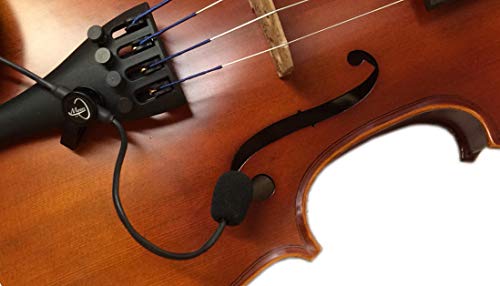 |
The Feather by Myers Violin Pickups | ★★★★★ | Check Price |
| 6 | 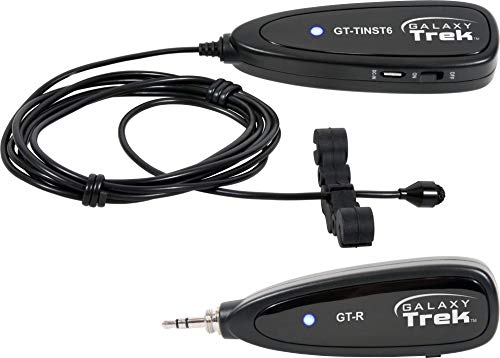 |
Galaxy Audio GalaxyTrek Wireless Clip-On | ★★★★★ | Check Price |
| 7 |  |
Shure PGA98H-TGQ Cardioid Condenser | ★★★★★ | Check Price |
| 8 |  |
VocoPro UV-3 Wireless System | ★★★★☆ | Check Price |
| 9 | 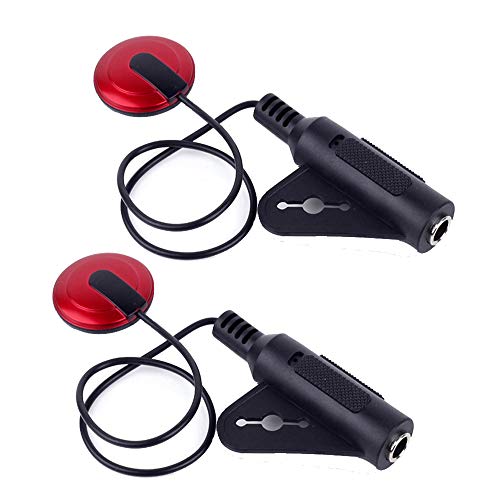 |
TraderPlus Piezo Contact Microphone | ★★★★☆ | Check Price |
| 10 |  |
IMELOD Contact Microphone | ★★★★☆ | Check Price |
1. Audio-Technica PRO 35 Cardioid Condenser — Best Overall
Audio-Technica PRO 35 Cardioid Condenser
You will come across several articles and reviews that talk about many other microphones for the violin, however, we feel that this is the best and this is our favorite.
Pros
- This device is excellent at capturing the most natural sound
- It's very strong and solidly built and we can practically tell that it will be very durable
- It's conveniently small and can generally be disassembled and packed up within a small space making it very easy to carry around
- It has a very common and standard adapter that comes with a low roll-off which makes it very much possible to switch to a different one
Cons
- Picks up room reflections and ambient noise easily
- More fragile than dynamic mics -- not ideal for rough handling
You’ll find plenty of blog posts championing other violin mics, but the Audio-Technica PRO 35 is the one I keep coming back to. It’s been my top choice for years now.
The mic comes with a 6-inch permanently attached cable, which keeps the design tidy and avoids connection issues mid-performance.
Its extended frequency response captures the most subtle nuances of your playing, whether you’re tracking in a studio or performing live. Nothing gets lost in the noise floor, and the highs stay silky instead of brittle.
The UniMount clip positions the mic exactly where you want it on the instrument and stays put while you play. It also acts as a shock absorber, which protects the capsule from the bumps and vibrations that come with any stringed instrument.
The cardioid polar pattern rejects off-axis sound from the sides and rear. That isolation matters when you’re sharing a stage with other instruments, since it keeps bleed from other sources out of your signal.
2. HEIMU Clip-On Instrument Condenser — Runner Up
HEIMU Clip-On Instrument Condenser
The HEIMU Clip-on Instrument Condenser Microphone has already made a name for itself amongst musicians, and it's used by beginners and experienced users alike.
Pros
- It's very easy to carry around
- It's very accurate at recording and practically doesn't change the sound from the source ie. the violin
- It's very easy to be placed on the instruments
- It's budget-friendly and won't take a toll on your wallet
Cons
- Wind noise requires a furry windscreen outdoors
- Audio quality doesn't match larger diaphragm mics
The HEIMU clip-on has quietly built a loyal following among musicians of every level. Beginners and pros alike reach for it, which says something about how versatile it is.
A detachable cable is one of its standout features. It makes storage easier and gives you options if you need to swap in a longer or shorter run for a specific gig.
It’s compact and clips onto the instrument quickly and securely. Beyond violin, it handles acoustic guitars, mandolins, ukuleles, and dobros, which is handy if you play more than one instrument.
The mounting system is small enough to position in almost any orientation, and most users find it delivers a noticeably more natural sound than built-in pickups. You can also adjust it one-handed mid-performance, which is genuinely useful on a busy stage.
Wireless adapters are available separately, which is where this mic gets clever. Instead of buying a whole new wireless mic when you need to cut the cable, you just swap in the adapter and keep your tone intact.
3. Fishman V-200 Classic Series — Best Value
Fishman V-200 Classic Series
Are you tired of mounting and placing microphones on your instrument and worried about how to have them perfectly placed so that, you can still carry on playing comfortably?
Pros
- It's very simple and easy to use and install
- It's made of excellent material and is practically very durable
- It's able to capture great quality sound
- Because it's so small and lightweight, it's incredibly easy to carry around
- It doesn't necessarily require a preamp as it allows ways to navigate around it
Cons
- Powder coat finish chips if knocked against hard surfaces
- Clutch mechanism requires periodic tightening
Tired of wrestling with mic placement every time you want to play? The Fishman V-200 takes that problem off the table entirely.
It’s a piezo-ceramic pickup that installs once and stays put, so you can focus on playing instead of gear.
The unit is feather-light, which matters when you’re holding your violin for an hour-plus set. You won’t feel it affecting the balance.
It supports muting, and it works with or without a preamp, so you can run it into whatever rig you’ve got and still get a clean, natural amplification of your violin’s voice. The quarter-inch output jack makes connecting to any amp or DI straightforward.
The V-200 also comes with an integrated chin-rest, which keeps the pickup positioned perfectly every time you pick up the instrument. It’s the kind of subtle design choice that pays off over hours of playing.
4. Luvay Acoustic Guitar Pickup — Top Pick
Luvay Acoustic Guitar Pickup
This device is a Piezo-Contact violin pick-up that also works as a microphone transducer for acoustic guitar, ukulele, mandolin, banjo, cello, kalimba, harp, etc.
Pros
- It's very small and easy to use and is also easy to carry around
- Its adhesive normally won't leave any mark or residue on your instruments and is reusable
- This transducer allows its users to control the volume of the sound
- It produces fairly clean and clear quality sound
Cons
- Build quality may not withstand heavy daily use
- Included accessories are basic and may need upgrading
The Luvay is a piezo-contact pickup that doubles as a microphone transducer for a whole zoo of stringed instruments. Violin, acoustic guitar, ukulele, mandolin, banjo, cello, kalimba, harp, you name it.
A control knob on the unit lets you adjust the volume without touching your amp. That’s a nice touch for quick onstage tweaks.
Installation is as simple as it gets. The self-adhesive mount holds the pickup securely to your instrument and peels off cleanly when you want to move it, leaving no residue.
In the box, you get a 10-foot amplifier cable and a standard quarter-inch jack, so it plugs into just about any amp or interface. Sound quality is surprisingly clean and focused, and it rejects off-axis noise almost like a directional microphone.
5. The Feather by Myers Violin Pickups — Top Pick
The Feather by Myers Violin Pickups
Some will argue that the violin pickups produced by Myers are the absolute best in the market.
Pros
- It captures a very natural sound
- It comes with a gooseneck that is very long-lasting
- It can be mounted in several different ways
- It's manufactured by a company that provides one of the best quality customer services to its clients
Cons
- Documentation lacks detailed setup guidance for beginners
- Frequency response may not suit all voice types equally
Some will argue that the violin pickups produced by Myers are the absolute best in the market.
The Feather is their latest lightweight variant and as its name suggests, it’s very light and is very easy to place suitably around your instruments.
Don’t let its size or lightweight shape fool you because it’s a very powerful device, and it’s capable of amplifying the natural tones of your instrument fantastically.
It comes equipped with an internally powered active preamp that produces the richest quality sounds coming off your instruments.
It also comes with a pre-installed power source and will not require any phantom power.
It features a battery that will keep supplying you with power steadily for hours.
It’s accessible for use with most wireless systems, including handheld microphone setups.
Myers thoroughly checks every product before shipping them out and therefore, you can be sure to receive excellent quality products from them every time.
It’s also made from very durable materials which indicate that it should generally be long-lasting.
It’s practically a plug-and-play device that is ready for use once you open it out from its box and easily mount it to your instrument.
It comes with a set of mounting equipment, and it will instantly help you to convert your instrument to an acoustic or electric instrument with volume control.
It can be used with most musical instruments too.
6. Galaxy Audio GalaxyTrek Wireless Clip-On — Worth Considering
Galaxy Audio GalaxyTrek Wireless Clip-On
If you are someone who wants to make their instrument wireless and be able to transmit your sound to your smartphone, then this is the perfect option for you.
Pros
- It produces excellent quality sound recordings
- It offers extended battery life support
- It has one of the widest wireless connectivity ranges
- It's practically very small and light, making it very easy to carry around
- It's made of good quality materials that practically ensures longevity
Cons
- Rechargeable batteries lose capacity over time
- Range decreases significantly through walls and obstacles
If you are someone who wants to make their instrument wireless and be able to transmit your sound to your smartphone, then this is the perfect option for you.
This device is very reliable and efficient at transmitting quality audio sound seamlessly to the receiving components of your PA System, Speakers, Computer, or even your smartphone.
If this isn’t convenient enough for you, it comes with a set of very energy-optimized and efficient internal lithium batteries that can be charged up by a simple USB.
The batteries of this device can last for up to even 6 hours, which is simply staggering.
That’s not all, the GalaxyTrek comes with a very long and wide range of up to 50ft of wireless connectivity which will allow you to move around distances that other devices simply won’t be able to match.
Another good news for smartphone users looking into the world of violin microphones is that this device comes equipped with adapter cables for both Android-based and Apple-based devices.
It features a very fantastic Omni-directional Condenser Microphone.
The overall capabilities of this device make it suitable for use by regular musicians performing on stage or in the recording studios.
It’s also suitable for more versatile musicians who brave the outside world to record sound for their YouTube channels, or doing street performances, giving lessons, etc.
7. Shure PGA98H-TGQ Cardioid Condenser — Worth Considering
Shure PGA98H-TGQ Cardioid Condenser
The first thing that will come to your mind when you pick up this device is the quality of the material it has been made out of, which is simply fantastic.
Pros
- It's very adept and efficient at recording great quality sound
- It's easy to be carried around
- It's made of excellent quality materials and is likely to last long
- It's good for being adjusted and mounted conveniently
Cons
- Self-noise floor is audible in very quiet recording environments
- Shock mount recommended to avoid stand vibration bleed
The first thing that will come to your mind when you pick up this device is the quality of the material it has been made out of, which is simply fantastic.
This makes this device very strong and long-lasting.
The Shure PGA98H-TGQ Microphone features an adjustable gooseneck, and it provides excellent flexibility for positioning and mounting it on board your instrument.
Since it comes with a Cardioid Condenser, it goes a long way in getting rid of all unnecessary noises from your surroundings when you are performing, meaning you’ll capture the best sound coming from your instrument.
The adjustable gooseneck also makes it possible to be adjusted for being mounted to your desired height.
This device also comes in two options whereby you can choose to buy the microphone with a preamp or without one.
8. VocoPro UV-3 Wireless System — Worth Considering
VocoPro UV-3 Wireless System
The VocoPro UV-3 U-series wireless violin system is a very unique device.
Pros
- This device is practically one of the best in minimizing interference
- It has one of the best wireless connectivity ranges
- It will make it possible for multiple sets to be used at the same time
Cons
- Battery life may not last through extended multi-hour events
- Signal can drop in environments with heavy RF interference
The VocoPro UV-3 U-series wireless violin system is a very unique device.
It’s great at getting rid of (to an extent) dropouts that come about from interferences.
It features a diversity receiver which makes it possible to carry out this function.
It also enables its users to implement multiple sets at the same time through its 16 operating channels.
If you thought that the GalaxyTrek has a great range in its wireless connectivity, then prepare to be surprised because this device features components that allow for 150 feet of wireless connectivity.
This device also features a squelch control which can be adjusted and once again will help you to wipe out outside interference. We’ve seen people use it for on stage performances and it holds its own there too.
It has a receiver that requires two AA batteries or a DC adapter for power.
9. TraderPlus Piezo Contact Microphone — Worth Considering
TraderPlus Piezo Contact Microphone
Featuring two units of Piezo Contacts that enables it to greatly balance the sound from even larger instruments, the TraderPlus Piezo Contact Microphone Pickup device had to be included in our list.
Pros
- It's fairly adept at capturing sound with clarity
- It's able to pick up a good range of frequencies too
- It's rather reasonably priced and is, therefore, a great value for the price
- Its two-sided adhesive tapes are a great advantage
Cons
- Documentation lacks detailed setup guidance for beginners
- Frequency response may not suit all voice types equally
Featuring two units of Piezo Contacts that enables it to greatly balance the sound from even larger instruments, the TraderPlus Piezo Contact Microphone Pickup device had to be included in our list.
It’s fantastic at filtering noises which allows it to capture sound with excellent clarity in perhaps any possible performance scenarios.
This mic is very simple and convenient to mount since it comes with two-sided adhesive tapes.
It’s also fairly adept at minimizing sound interferences from nearby sources.
Its user-friendliness makes it appropriate for use by beginner and experienced musicians alike.
Its double Piezo contacts make it ideal for use with several musical instruments other than just the violin, including trumpet.
10. IMELOD Contact Microphone — Worth Considering
IMELOD Contact Microphone
This is a device that is not only suitable for violins but also guitars, cello, banjo, ukulele, mandolin, etc.
Pros
- It's tiny and thus it's effortless to be carried around
- It has a very low price and therefore is excellent value for money
- It's also very user friendly for mounting
- It's excellent at amplifying recorded sound
- It's fairly good at minimizing interferences
Cons
- Mounting thread size may differ from your existing gear
- Performance varies depending on the quality of your audio chain
This is a device that is not only suitable for violins but also guitars, cello, banjo, ukulele, mandolin, etc.
It needs to be able to contact the sound surface to be able to function properly and capture great quality sound.
It’s also fairly adept at minimizing sound interferences from outside and nearby sources.
It features a socket that is suitable for universal cable with the 6.35mm jack male plug.
The device comes with self-adhesives and two-sided velcro to enable you to mount it up on musical instruments conveniently.
It’s a great choice in acoustic setups as well.
It’s one of the smallest devices on our list and will easily fit inside your pockets.
Frequently Asked Questions
Should I use a clip-on mic or a piezo pickup for my violin?
A clip-on condenser mic captures the natural acoustic sound of your violin more faithfully, making it better for studio recording and classical performances. A piezo pickup attaches directly to the body and works better for live performances where feedback rejection and volume are priorities.
Will clipping a microphone to my violin damage the instrument?
No, properly designed clip-on instrument mics use soft padding and gentle spring clamps that won’t scratch or damage your violin. Models like the Audio-Technica PRO 35 are specifically engineered to be instrument-safe.
Just avoid over-tightening the clamp.
Can I use a regular vocal microphone to record violin?
You can, but the results usually won’t be ideal. Vocal mics are tuned for the human voice frequency range and may not capture the full tonal range and harmonics of a violin.
A dedicated instrument mic or small diaphragm condenser placed 6 to 12 inches from the f-holes will give you much better results.
Final Thoughts
Choosing the right mic or pickup comes down to how you actually play. A studio player chasing pristine fidelity needs something very different from a touring musician who amplifies their violin through a loud PA every night.
Think about how often you’ll actually play plugged in. If it’s rare, a basic clip-on condenser is all you need.
If it’s a regular gig, investing in a piezo pickup or a higher-end mic pays for itself pretty quickly.
At the end of the day, it’s a matter of personal preference. Modern sound engineering gives violinists more options than ever, and most of them work well enough that you’ll get good results whichever direction you go.
What matters most is being informed about what you’re buying. Hopefully this list gave you enough to make a confident choice and find a mic that does justice to your playing.
The Audio-Technica PRO 35 Cardioid Condenser is our top pick for its natural sound capture, solid build quality, and compact clip-on design that makes it easy to carry between gigs. If you want something even more portable and budget-friendly, the HEIMU Clip-On Instrument Condenser is a lightweight option that clips directly onto your violin without altering the sound.